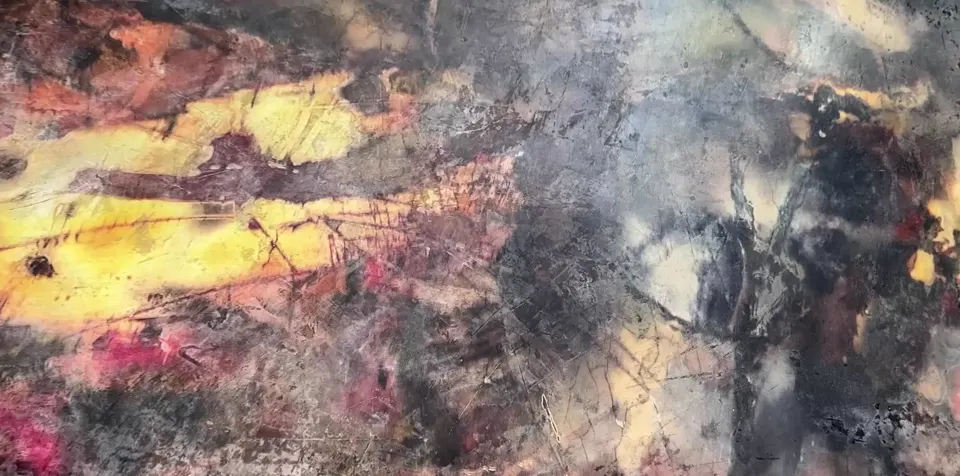
The world today is changing faster than it can be painted. Art must keep pace. And that means only one thing: it must never come to a standstill.
A Calmed Imagination
Piotrków Trybunalski, 9 October 2026
At painting exhibitions, a question is being asked more and more often: does art have the courage to accept that its task is no longer to show the world, but to create the conditions for understanding it? From the very beginning, whatever form it has taken, art has sought to describe the world and the human being within it (that is, what we see, hear and feel).
Today, things are probably much the same. But… what if the world is changing so quickly that art can no longer keep up with “painting” it? The human figure begins to blur, as in a photograph taken with a moving camera. It becomes a grey, increasingly indistinct shape. Art, in crisis, slows down. It wants to attend to the human being. But that person is no longer there. There is only an incomprehensible image of a reality rapidly receding into the distance. We can no longer see anything. Only occasionally does someone try to create an image for us, often hurting us in the process and dulling our sensitivity. Sensitivity — our means of understanding the world — is reduced to emotions. Mostly negative ones. What remains? A calmed imagination?
The world exists above all in the imagination, which is why it should not be built according to patterns and schemes devised elsewhere, through blind or even slightly modified copies of them. There is no universal, ready-made method.
We can see this clearly in the superworld of the superpowers.
We can see it clearly in painting.
We can see it clearly in ourselves. Calmed.
A painting is sensitive to the act of looking. It is often capricious. Complete clarity of meaning and the full intensity of experiencing form cannot be had at the same time.
When you “tighten” the meaning, you often lose the pure energy of form.
When you “tighten” the form, the meaning becomes less literal.
The more you insist on an unambiguous answer to “what does it mean?”, the less remains of “how does it work?”.
The painting begins to be measured by a standard other than “resemblance to things”.
We are not looking for answers, but for experiences that awaken something undefined, perhaps even unsettling, yet fascinating at the same time. It is a journey in which every moment is full of intensity, as though the boundaries between reality and imagination were constantly shifting. And perhaps it is precisely this state of suspension — between desire and reality — that makes the journey so intriguing.
At a certain point, the relationships that have been present in the painting from the beginning form a tension that cannot be ignored. We begin to see more — not because the painting changes, but because a particular way of seeing is set in motion. It becomes unclear whether the painting is revealing further layers or the viewer is beginning to see in a way that was previously beyond their reach. It is not merely about creating paintings, but about creating the conditions for seeing.
This change is not accidental. It comes from a method developed consistently over the years. Its aim is not simply to shape a physical surface, but to create a situation in which seeing ceases to be automatic. Attention shifts from the painting itself to what happens on the other side — in the viewer. It is no longer about a simple relationship between the work and its interpretation, but about the moment when looking deepens. This is why the emphasis shifts so clearly towards the person who is looking.
Looking ceases to be a reflex and becomes a decision. Then it is not only the paintings themselves that become visible, but also the tensions, relationships and shifts that may previously have gone unnoticed. What was meant to remain in the background begins to claim our attention. It is here that an experience takes shape which does not end when we stop looking.
Any of us can do this with a painting that catches our eye: lose ourselves in looking. Beyond language, without the faintest idea. It is always worth doing, and not only in galleries. It protects our shared world from totalisation, from being reduced to an average, from greyness.
At painting exhibitions, a question is being asked more and more often: does art have the courage to accept that its task is no longer to show the world, but to create the conditions for understanding it? From the very beginning, whatever form it has taken, art has sought to describe the world and the human being within it (that is, what we see, hear and feel).
Today, things are probably much the same. But… what if the world is changing so quickly that art can no longer keep up with “painting” it? The human figure begins to blur, as in a photograph taken with a moving camera. It becomes a grey, increasingly indistinct shape. Art, in crisis, slows down. It wants to attend to the human being. But that person is no longer there. There is only an incomprehensible image of a reality rapidly receding into the distance. We can no longer see anything. Only occasionally does someone try to create an image for us, often hurting us in the process and dulling our sensitivity. Sensitivity — our means of understanding the world — is reduced to emotions. Mostly negative ones. What remains? A calmed imagination?
The world exists above all in the imagination, which is why it should not be built according to patterns and schemes devised elsewhere, through blind or even slightly modified copies of them. There is no universal, ready-made method.
We can see this clearly in the superworld of the superpowers.
We can see it clearly in painting.
We can see it clearly in ourselves. Calmed. A painting is sensitive to the act of looking. It is often capricious. Complete clarity of meaning and the full intensity of experiencing form cannot be had at the same time.
When you “tighten” the meaning, you often lose the pure energy of form.
When you “tighten” the form, the meaning becomes less literal.
The more you insist on an unambiguous answer to “what does it mean?”, the less remains of “how does it work?”.
The painting begins to be measured by a standard other than “resemblance to things”.
We are not looking for answers, but for experiences that awaken something undefined, perhaps even unsettling, yet fascinating at the same time. It is a journey in which every moment is full of intensity, as though the boundaries between reality and imagination were constantly shifting. And perhaps it is precisely this state of suspension — between desire and reality — that makes the journey so intriguing.
Drag the handles to change the order in all views. Click an image to enlarge it.
Exhibitions
Everyone knows that moment: losing oneself in looking. Beyond language, without the need to name or explain anything at once. It is worth practising not only in galleries. It protects our shared world from flattening into sameness and greyness. That is why painting exhibitions cannot be limited to arranging works and explaining their meanings. They must be demanding. They must turn abstraction into colour, and condense repeated gestures into a trace that endures.
An exhibition is not merely a presentation of works. It is an attempt to touch the place where art has not been reduced to commentary, document, or illustration of its time. Touch precedes the other senses. When something is touched, it reveals itself at once. This is how painting works: not everything needs to be named in order to act. Sometimes more important than understanding is a kind of attention that cannot be rushed or replaced.
Successive exhibitions do not form a sequence of places and dates. They form a sequence of questions: can painting retain its own current? Can an image exist other than as a copy of a copy? Can art still operate like a mystery one can hold within — not as decoration or a subject of discussion, but as an experience that alters the way we see?
If the age of the avant-gardes is coming to an end, it is not because art has stopped searching for new forms. The world is changing faster than it can be painted. This is not a reason for nostalgia or for defending former orders. It is a point of departure for painting in the twenty-first century. Art cannot come to a halt. Nor can it pretend it must keep pace with the speed of technology. That is not its tempo.
The question arises: what can painting do if it refuses to become a copy of someone else’s rhythm, another image of a world simplified and delivered for immediate use? Its task is not to race change, but to maintain its own measure. Not to stop, and not to lose its own way of enduring. Not to imitate haste, but to build conditions of seeing that do not yield to what is ready-made.
The canvas is neither glossy paper nor a glowing screen. It does not serve digital photography or the testing of technological capabilities. It is not a site for reproducing a reality seized in haste, handed down through someone else’s vision, increasingly filtered by systems faster than human attention. The time of art dependent on time itself is coming to an end. This is not a retreat from the present, but a refusal to submit to its most elementary mechanisms.
Chełm, 2024 — photo: Marek Szymański
The stakes of this work are clearly visible. Painting is not a safe domain of individual expression. It is a field governed by principles independent of both technology and the human. It is not the human who holds power over it. Nor does AI determine its essence. For the painter, every moment remains unstable and essential.
Everything and nothing. Everything that brings one closer to being fully awake. A new definition of art will not arise through generation. The algorithm for writing about art is not ready. Art must defend what cannot be ordered into instruction, program, or nomenclature. In this resistance to easy translation, its real strength begins.
Tarnów, 2026 – Quarter Is Enough
Railway stations follow their own rhythm. They are spaces of passage, haste, and brief pauses — places where nothing usually demands prolonged attention. Within Tarnów station there is the intimate space of the BWA Gallery — set apart, yet not cut off from the world that continually flows past it. The title of the exhibition promises only this: “Quarter Is Enough”. Only after a moment does it become clear that this is not about the time needed to move through the exhibition, but about the moment in which looking ceases to be superficial and begins to operate with precision, selectivity, and awareness. It settles where previously there had been no reason to stop. Not because something has been added, but because something has been set in motion.
Tarnów, 2026 — photo: Przemysław Sroka
At a certain point, the relationships that have been present in the image from the beginning arrange themselves into a tension that cannot be ignored. One begins to see more — not because the image changes, but because a particular mode of seeing is activated. It becomes unclear whether the image is revealing further layers, or whether the viewer has begun to see in a way that previously lay beyond their reach. It is here that the logic of this work becomes most evident: it is not merely about creating images, but about constructing the conditions of seeing.
This shift is not accidental. It arises from a method developed consistently over the years. Its aim is not only the material shaping of the surface, but the organization of a situation in which seeing ceases to be automatic. Attention is displaced from the image itself to what takes place on the other side — in the viewer. It is no longer a simple relation between the work and its interpretation, but a moment in which looking deepens. That is why the weight so clearly shifts here toward the person who is looking.
Tarnów, 2026 — photo: Przemysław Sroka
In Tarnów, what lies in between takes on particular significance — not as a concept, but as an experience of perception. It appears at the moment when looking ceases to be a reflex and becomes a decision. Then it is not only the images themselves that become visible, but also the tensions, relations, and shifts that may previously have gone unnoticed. What was meant to remain background begins to claim attention. It is precisely here that an experience emerges which does not end when the viewing does.
The images operate both in the present and beyond it. They return when the eyelids close. They reorganize memory. They alter the way details begin to arrange themselves. Their effect does not end within the space of the exhibition — the proper site of their action begins where the viewer composes them within themselves. This says much about the sensibility from which these works arise. It is not a sensibility focused on spectacle or on immediate effect. It is selective, alert, distrustful of the obvious, and at the same time open to what reveals itself only over time.
Tarnów, 2026 — photo: Przemysław Sroka
In this sense, Tarnów is not merely another exhibition. It is a place where the problem of contemporary painting is posed with particular sharpness. Today there is a desperate attempt to keep pace with the rhythm of change — of almost everything, including art. In this haste, art increasingly begins to imitate copies of everyday life, borrowed ways of seeing, images taken from circulation and handed to us by a system that no longer even requires an author to produce intensity. In such a world, painting can easily lose its own ground. Not because it becomes weaker, but because it too readily accepts terms set by others.
Painting loves to be spoken about. It knows that what is said about it shapes its condition, its presence, its circulation, and sometimes even its prestige. A multitude of listeners will not give it strength. It may add splendour, but it cannot replace the tension that arises between the image and the act of looking. That tension does not emerge in noise. Nor does it appear where art becomes merely a commentary on an accelerating present. The world accelerates without end, and yet it is precisely in such a world that painting must preserve its own capacity to endure.
Tarnów, 2026 — photo: Przemysław Sroka
The colours of the world quickly lose their clarity in eyes accustomed to excess. Not because they have faded, but because they have been drawn into a circulation that knows no rest. The glaring sun does not go out — it merely yields its force elsewhere. To look through colour is slower. Colour cannot capture every stage of change. It congeals — and it is precisely this stillness that becomes its strength. The image does not have to compete with reality. It does not have to pretend to be a device faster than devices. It does not have to penetrate technology in order to justify its own existence.
This is not a race. Still less a noisy, mechanical race, fascinated with movement itself. It is better to observe this all-encompassing rush from the side, while preserving one’s own point of grounding. The world is full of beautiful details that seduce the senses. That is not enough. The details of art are not born from replicating the details of the world. They arise on the canvas. That is why it is not worth copying copies.
Tarnów, 2026 — photo: Przemysław Sroka
That is precisely why Tarnów extends beyond the framework of a single exhibition. The same logic has been transferred to the website, where the images do not function merely as documentation, but continue to operate. The panel launched alongside the exhibition allows one to pause longer, to juxtapose images, to mix them, to follow their tensions, and to observe layers of structure that emerge only in relation. One can return to the works, confront them with one another, and observe the most recent ones — not yet shown or previously published. This is not an addition. It is a continuation of the same mode of thinking that organizes the whole. The image does not end on the gallery wall. It continues to work as a system of tensions, relations, and signatures.
In this sense, Tarnów presents not a finished mechanism, but a mechanism in operation. It reveals something that has earlier stages and further consequences. It is not the end of a process. It is a moment in which it becomes clear that what is at stake in these images is not the representation of reality, but the transformation of the very act of looking.
Chełm, 2024 – Mobilneur
In Chełm, the language that would later be developed first emerged with particular clarity. It took shape in the space of a former church, where an art gallery has long been active. The space itself does not function as decoration or metaphor, yet it is not indifferent. The focus, rhythm, quiet, and discipline of the place bring out the weight of what is only just coming into being. Nothing distracts. Nothing diminishes the significance of what is becoming visible.
It is here that a new cycle of paintings, all in a rigorously identical format, was shown for the first time. They all belong to a single order. Each bears the characteristic rounded corners that immediately draw attention and remain in memory as something more than a formal detail. This is the first exhibition in which this language appears with such clarity: closed, repetitive, deliberately constructed. Yet there is no monotony here. On the contrary — the more insistently the same form returns, the more distinctly the differences emerge. Repetition works like a mantra. It does not limit the image; it clears the field of vision. It sharpens it.
Here it becomes most evident that form is not merely a matter of form. The uniform format, the corners, and the rigour of repetition can be described in the language of art history, but such a description does not reach the essence of the matter. What is most important arises from a specific kind of mental discipline. It is not about improvised emotionality or a moment of inspiration. It is about a sensibility sustained in a state of constant readiness.
The source of this consistency lies elsewhere — in a daily gesture that is repeated earlier and more often. In painting on the back of a phone. It is the phone that is constantly present, closest at hand, immediately available. Not a sketchbook, not a canvas, not an easel. The phone. It is on its reverse that impulses, configurations, and tensions are recorded. In Chełm, several such phones were shown alongside the paintings, and it became clear that the large format is not the beginning, but the consequence.
At the centre of this space stood a table brought from a private studio. Not as decoration, but as a trace of practice. It was there that the making of a miniature was shown. When painting takes place on a little girl’s phone, and the medium and tools are then passed on, the scene ceases to resemble an ordinary workshop. It becomes an act of transmission — of a practice, a rhythm of work, a mode of concentration, a belief in the meaning of the gesture. What is seen on the wall turns out to have been worked through earlier, at a scale that fits in the hand, embedded in the fabric of everyday life.
This says a great deal about the structure of this work. Painting on the back of a phone is not a curiosity or the effect of a contemporary prop. It is a decision that art should remain constantly with the human being, just as the world passing through attention is constantly present. The developed medium makes it possible to carry art at all times, and with it, one’s own way of seeing. This way of seeing is sharpened, checked and put to the test every day. It is not a practice reserved for special occasions. Walczak has been painting on phones since 1997 — not only when he has time, but also during meetings, while travelling, in restaurants, in places where others do not expect the presence of art. It is precisely this continuity that proves to be crucial.
Equally important is the material of the image. The medium developed in the Atlas laboratory gives the surface density, hardness, and depth of colour. The surface works in layers, absorbs successive decisions, sustains tension and responds to light. The medium can also be used to paint on the back of a phone. At this point, daily practice, material, and exhibition meet with particular clarity for the first time. Chełm does not yet close this language, but allows us to see that it already exists.
From this stance emerges the word “Mobilneur” — a fusion of “mobile” and the figure of the flâneur, described by Baudelaire and later developed by Benjamin. It is not a catchy title, but the name of a particular way of being in the world. The flâneur does not move through the city in order to achieve a result, but in order to see intensely. He does not conquer reality, but allows it to reveal itself. Benjamin extends this figure further: the flâneur begins to read the city as a text, to assemble its fragments, to recognize structures and tensions invisible at first glance.
The Mobilneur carries this movement into the age of the phone. He does not so much walk through the city as carry its possibility with him. He is ready. He receives impressions before they become information. He does not master the world, but lets it pass through his own sensibility. This reveals the psychological dimension of this work: a distrust of ready-made images, and at the same time an openness to what is not obvious, not yet named, only just emerging from experience.
This is why Chełm holds particular significance. Not only because it is the first time that paintings conceived from the outset without imitating reality are shown. Also because it becomes visible how form, material, rhythm of work, and a way of being in the world intertwine into one. Previously, reality passed through the lens of the camera until it began to operate differently. Here, the image is already born on the other side. Not as a rupture with the earlier path, but as its consequence.
And if it is a consequence, something must have prepared it.
Hünfeld, 2008 – The Tracks
There are moments in an artist’s practice that do not leave behind a single work, but alter everything that follows. The “Tracks” series is one of them. At first glance, it appears to be a narrowing: a return to a single motif, a single arrangement, a single decision repeated consistently across successive works. But this is only an illusion. In reality, the opposite is taking place. It is here, for the first time with full force, that repetition reveals itself as a tool of disclosure rather than limitation.
In the “Tracks” series, rigour is defined with almost laboratory precision. Each work is produced according to identical premises: the same format, the same compositional axis determined by the parallel lines of tram tracks. Repetition does not limit the image. It eliminates randomness and takes control of the gaze. What initially appears obvious and recognizable — the tracks themselves — very quickly loses its dominant role. Attention shifts into the space between them: into the paving, the cracks, the fissures, the microscopic differences that previously carried no significance. What was meant to be background begins to take control of perception.
At this point, a remark by Krzysztof Cichoń proves particularly apt, describing works in which “a mere few million pixels have been multiplied into myriads of details.” This sentence captures not only the density of these images, but also the nature of this perception. Reality is not simplified. It is condensed. Seeing ceases to rely on quick recognition and begins to operate at the level of structure.
At a certain point, the image begins to function differently. It remains mimetic — it still refers to reality and can be recognized — but it no longer confines itself to it. It does not so much represent reality as filter and transform it into a system that operates primarily at the level of perception. This shift is crucial. It is here, for the first time with particular clarity, that something emerges which will later become central to subsequent cycles: the image as a tool for constructing attention.
In this sense, “Tracks” is not a choice of motif. It is the consequence of a particular kind of sensibility: distrustful of what is obvious, and drawn to what reveals itself only through sustained attention. It is here that a method becomes visible, one that will later be developed further. What had previously been dispersed — rhythm, repetition, the experience of structure, the displacement of attention from the main motif toward what lies in between — is gathered into a single, rigorous framework and, for the first time, carried through to completion.
The tracks do not guide the gaze in a straightforward way. They hold it in tension. They do not allow the image to be quickly closed by meaning. This says much about the relationship with the viewer. The image does not offer a ready-made sense. It compels active presence. It shifts the weight from recognition to participation. That is why it remains so taut: it stands precisely on the threshold. It still shows the world, and already begins to detach itself from it.
At the same time, one of the most important intuitions of this work becomes clear here: the tracks do not appear in the image in order to indulge in a dream about them. They appear in order to be taken into the realm of art. This is not about decorative art, nor about art that serves as an efficient commentary on reality. It is about strong art. About art charged with tension. About art that can be held within oneself like a secret.
Art is not a problem to be solved. It cannot be repaired in the way one repairs warped or water-damaged tram tracks. And yet without these tracks, art would not survive — without its relation to matter, movement, damage and repair, without the tension between order and deformation. Here one of the most paradoxical intuitions of this painting emerges: art cannot be repaired, and yet, in its own way, it repairs seeing.
All the more so today, when tramways, in various ways, encroach upon the domain of art. Sometimes literally, sometimes as a ready-made image of everyday life, and sometimes introduced by AI as an element of an already processed world. The distinction between infrastructure and image thus becomes all the more important — between the technical order of things and that which, in art, escapes function. It is precisely here that painting regains its own current.
The exhibition at the Museum Modern Art in Hünfeld was an important earlier international stage for the “Tracks” series and for the presence of these works within a broader European context. Paintings previously shown in Lviv, Kyiv, and Prague entered there into a setting in which the maxim of Gerhard Jürgen Blum-Kwiatkowski resonated with particular force: not to go with the current, nor against it, but to find one’s own current. It is difficult to imagine a more fitting statement for this cycle. Here, the tracks are not merely a trace of movement. They are an attempt to locate painting’s own current — one that yields neither to the pressure of subject nor to the pressure of time.
For this reason, Hünfeld remains significant not only as a point in the history of exhibitions, but as a moment in which the method becomes distinctly visible. It is here that one most readily understands that an image can operate not through the multiplication of effects, but through consistency. Not through excess, but through rigour. Not by chasing reality, but by condensing it in such a way that something more than the world itself begins to reveal itself.
Andrzej Walczak
An architect and architecture graduate of Lodz University of Technology, entrepreneur and co-owner of the Atlas Group — the largest Polish manufacturer of construction chemicals, founded in 1991. Founder and owner of Atlas Sztuki, regarded as one of the most important non-commercial contemporary art galleries in Poland.
Andrzej Walczak, Chełm, 2024 — photo: Marek Szymański
A native of Łódź, and the originator of the concept for the city’s transformation and the creation of the New Centre of Łódź. His works have been presented in both solo and group exhibitions, including at the Museum Modern Art in Hünfeld, the Polish Institute in Prague, the Gallery of the Foundation for Contemporary Art in Kyiv, Dzyga Gallery in Lviv, Kryga Gallery in Grodno, as well as in galleries in Kraków, Warsaw and Łódź.
Łódź is rich in legends about how “this city” has changed people. Such transformation, as myth, becomes a way of remembering the intense social upheavals that took place in the great industrial “molochs” of urbanization in the 19th and 20th centuries. Perhaps because life here can truly unsettle and sway you.
In such conditions, what is imagined directly superimposes violence, agency, desire, domination, and submission. It is a simple, dispassionate and ruthless force, like a working machine — one that can be used for mass production. It hardly matters what counts more: its scale, its speed (the number of changes), the expansion of distribution networks, the conquest of the market, and ultimately, profit.
Industrial (and post-industrial) cities are still often described like sports cars, with an abundance of technical parameters, while rarely reflecting on the instinctive forces and impulses that such a symbolic specification activates within us.
Walczak has spent his entire life in Łódź. He took refuge in the city, freed himself from Switzerland and discovered his own way of painting — strange, suspended somewhere between disembodied sanctity and painful cruelty. Somewhat like the character of Łódź itself.